Skip to content


- The Ultimate Guide to Rhinoplasty: Everything You Need to Know Before Your Nose Job
- Table of Contents
- Understanding Rhinoplasty Aesthetics and Techniques
- Pre-Op Preparation and Surgical Risks
📑 On this page (7)
- The Ultimate Guide to Rhinoplasty: Everything You Need to Know Before Your Nose Job
- Table of Contents
- Understanding Rhinoplasty Aesthetics and Techniques
- Pre-Op Preparation and Surgical Risks
- Recovery, Pain Management, and Post-Op Guidelines
- Post-Op Results, Expectations, and Revisions
- Planning Your Medical Tourism Journey
The Ultimate Guide to Rhinoplasty: Everything You Need to Know Before Your Nose Job
If you are considering aesthetic or functional nasal surgery, it is completely normal to have questions about the procedure, recovery, and results. As a leading clinic specializing in facial aesthetics, we have compiled the most frequently asked questions to help you make an informed decision.
Table of Contents
Get a Personalized Surgical Plan From Prof. Dr. H. Baki Yılmaz
Send your facial profile photos via WhatsApp for a free preliminary evaluation or book an in-person consultation at our Kadıköy Bağdat Avenue clinic in Istanbul.
Understanding Rhinoplasty Aesthetics and Techniques
Male vs. Female Rhinoplasty: What Are the Aesthetic Differences?
The goal of ethnic and gender-specific rhinoplasty is to enhance natural facial harmony while preserving unique characteristics. Female rhinoplasty often focuses on creating a softer profile, featuring a gentle curve on the nasal bridge (dorsum) and a slightly more elevated tip (with a nasolabial angle of 95 to 105 degrees). Conversely, male rhinoplasty aims to preserve masculine facial features. The aesthetic ideal for men typically involves a straighter, stronger bridge and a less elevated tip (around a 90 to 95-degree angle). Every surgical plan is customized to fit the patient’s specific facial structure rather than applying a one-size-fits-all approach.
What Makes a Nose Beautiful? Defining the Ideal Aesthetic Nose Shape
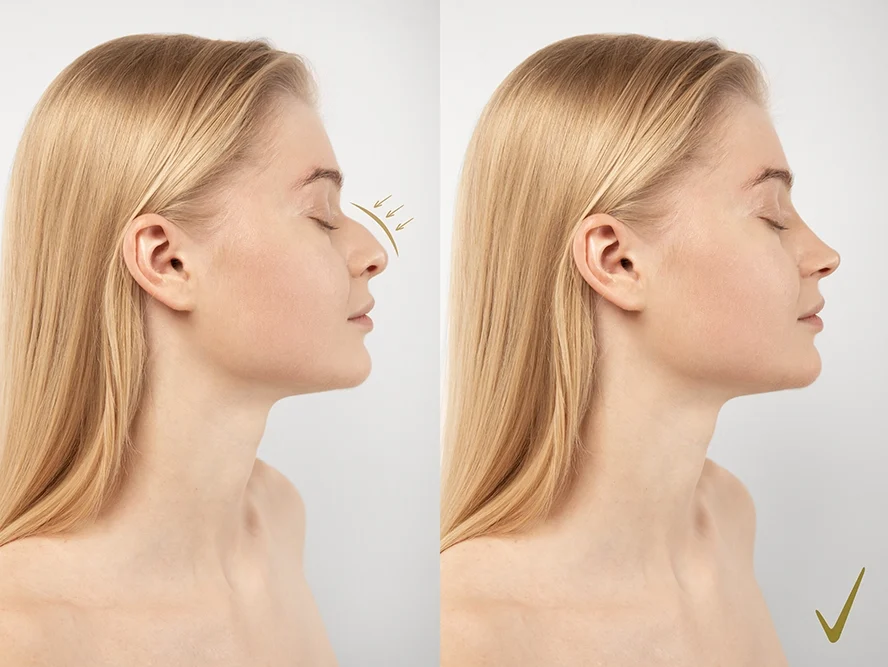
In modern facial plastic surgery, there is no single “perfect” nose. A truly beautiful nose is one that looks entirely natural and adheres to the principles of facial harmony and the golden ratio. The ideal aesthetic shape depends heavily on analyzing your specific facial proportions, chin projection, forehead slope, and skin thickness. The goal is not to create an artificial, “operated” look, but rather to refine the nasal contours so they seamlessly complement and elevate your unique facial features.
Advanced Techniques: Which Devices Are Used in Aesthetic Rhinoplasty?
To deliver the highest precision and minimize tissue trauma, we utilize state-of-the-art technology, primarily Ultrasonic Piezo Rhinoplasty. Unlike traditional methods that use a hammer and chisel, the Piezo device uses ultrasonic vibrations to precisely reshape and sculpt the nasal bones without damaging the surrounding soft tissues, blood vessels, or cartilage. This advanced technique leads to significantly less post-operative bruising, minimal swelling, and a much faster overall recovery timeline for our international patients.
Combination Surgeries: What Operations Can Be Performed with Rhinoplasty?
Rhinoplasty is highly versatile and is frequently performed alongside other procedures to optimize both function and facial aesthetics. Functionally, it is most commonly combined with a Septoplasty (to correct a deviated septum) or turbinate reduction to significantly improve nasal airflow and cure breathing issues—this is known as a Septorhinoplasty. Aesthetically, it is often paired with Mentoplasty (chin augmentation). Enhancing a weak chin at the same time as refining the nose dramatically improves overall facial symmetry and profile balancing.
Liquid Rhinoplasty: Is Non-Surgical Nose Job Suitable for Large Noses?
A liquid rhinoplasty, which involves injecting hyaluronic acid dermal fillers, is an excellent temporary solution for smoothing out minor dorsal humps, lifting a drooping tip, or correcting slight asymmetries. However, it is fundamentally an additive procedure. Because it adds volume, it is generally not suitable for making a large nose smaller or narrower. If your goal is to reduce the overall size of your nose, remove excess bone or cartilage, or fix structural breathing issues, surgical rhinoplasty is the only effective solution.
Celebrity Rhinoplasty: How to Achieve Natural-Looking Results
It is very common for patients to bring reference photos of celebrities to their consultation. While these photos are excellent tools for communicating your aesthetic preferences, a responsible surgeon will not simply “copy and paste” a celebrity’s nose onto your face. A nose that looks perfect on Angelina Jolie or Bella Hadid may not suit your distinct bone structure or ethnicity. Achieving natural-looking rhinoplasty results requires a bespoke surgical plan designed specifically for your anatomy, ensuring the final outcome enhances your own intrinsic beauty.
Pre-Op Preparation and Surgical Risks
What is the Minimum Age Requirement for Rhinoplasty Surgery?
Rhinoplasty should only be performed once a patient has reached full facial skeletal maturity. Operating prematurely can interfere with natural bone development. Anatomically, this milestone is usually reached around age 16 or 17 for females and 17 or 18 for males. Beyond physical readiness, emotional maturity and having realistic expectations are critical prerequisites for anyone considering cosmetic surgery.
Pre-Op Care: When Should I Stop Drinking Alcohol Before Rhinoplasty?
Proper pre-operative preparation is vital for a smooth surgery and rapid recovery. Patients must strictly avoid alcohol consumption for at least 1 to 2 weeks prior to surgery. Alcohol acts as a systemic blood thinner, which can significantly increase the risk of excessive bleeding during the operation. Furthermore, alcohol compromises the immune system and increases the likelihood of severe post-operative bruising, swelling, and prolonged healing times.
What Are the Risks and Complications of Rhinoplasty Surgery?
Rhinoplasty is generally a very safe procedure when performed by an experienced, board-certified specialist. However, as with any surgical intervention under general anesthesia, there are potential risks. General risks include minor bleeding, infection, or adverse reactions to anesthesia. Specific rhinoplasty complications may involve temporary numbness, nasal septal perforation, slight breathing irregularities, or asymmetry requiring a minor revision. Choosing a highly qualified surgeon who utilizes modern, atraumatic techniques significantly minimizes these risks and ensures high patient safety standards.
Nasal Fracture Symptoms: How Do I Know If My Nose is Broken?
A nasal fracture is the most common type of facial injury. Immediate symptoms of a broken nose include acute, sharp pain following facial trauma, noticeable swelling, bleeding from the nostrils, and difficulty breathing. Aesthetically, you may observe a sudden crookedness or a newly formed bump on the bridge. Another hallmark sign is the rapid development of dark bruising around and under both eyes, often referred to as “raccoon eyes.” If you suspect a fracture, prompt medical evaluation is necessary to reposition the bones before they heal improperly.
Recovery, Pain Management, and Post-Op Guidelines
Is Rhinoplasty Painful? Pain Management After a Nose Job
A common misconception is that a nose job is highly painful. In reality, most patients describe the sensation as uncomfortable pressure or heavy congestion, similar to a severe cold, rather than sharp pain. This is primarily due to internal swelling and the presence of nasal splints. Any post-operative discomfort is effectively controlled with standard oral pain medication prescribed by your surgeon. Once the silicone splints are removed—usually within 5 to 7 days—patients experience immediate relief and a significant improvement in breathing.
Do I Need to Stay in the Hospital Overnight After Rhinoplasty?
Yes, patient safety is our highest priority. Following a nose surgery performed under general anesthesia, patients are required to stay overnight in our fully equipped, internationally accredited hospital for one night. This 24-hour observation period allows our dedicated medical team to monitor your vital signs, administer intravenous (IV) antibiotics and pain relief, and apply immediate ice therapy to minimize initial facial swelling before you are safely discharged to your hotel.

Rhinoplasty Recovery Timeline: When Can I Return to Work?
The initial rhinoplasty recovery period is surprisingly quick. Most patients feel well enough to return to a desk job, remote work, or light daily activities within 7 to 10 days, typically right after the external cast and internal splints are removed. However, minor swelling will still be visible. For those with physically demanding jobs or who engage in heavy lifting and strenuous exercise, it is strongly advised to wait at least 4 to 6 weeks to prevent an increase in blood pressure that could trigger bleeding or prolonged swelling.
Post-Op Guidelines: How Soon Can I Drive After Nose Surgery?
You are not permitted to drive yourself home from the hospital. Generally, you should refrain from driving for at least 5 to 7 days post-surgery. You must wait until you have completely stopped taking prescription pain medications, as they impair cognitive function and reaction times. Furthermore, it is safest to resume driving only after your nasal cast is removed, ensuring that post-operative swelling around the eyes does not obstruct your peripheral vision.
Post-Op Results, Expectations, and Revisions
Will My Nose Tip Drop After Rhinoplasty? (Nose Tip Ptosis Explained)
It is completely normal to experience a slight, temporary drop in the nasal tip during your rhinoplasty recovery process. Immediately after surgery, the nose tip is often intentionally positioned slightly higher (over-rotated) by the facial plastic surgeon. As post-operative swelling subsides and the tissues relax over the first few months, gravity naturally allows the tip to settle into its final, perfectly balanced position. Advanced surgical techniques, including the use of strong cartilage grafts, are utilized to support the tip and prevent unwanted drooping (ptosis) in the long term, ensuring permanent and aesthetic results.
When Does the Nose Tip Drop and Settle After Rhinoplasty?
Patience is key when evaluating your final rhinoplasty results. The initial “drop” from its immediately post-op elevated position happens within the first 6 to 12 weeks. However, because the skin at the nasal tip is the thickest part of the nose and retains lymphatic fluid the longest, it is the last area to fully heal. You will see about 80% of the final result by month 6, but it takes 12 to 18 months for the nose tip to completely settle, soften, and reveal its final refined definition. Patients with thicker skin may require up to 2 years for all micro-swelling to disappear.
Not Satisfied with Your Nose Job? A Guide to Revision Rhinoplasty
If you are unhappy with the aesthetic appearance or experiencing breathing difficulties after a procedure performed elsewhere, Revision Rhinoplasty (Secondary Rhinoplasty) can address these concerns. Revision surgeries are technically more complex due to altered anatomy and the presence of scar tissue. Therefore, it is absolutely crucial to wait a minimum of 12 to 15 months after your primary surgery before undergoing a revision. This waiting period ensures all internal swelling has subsided and the scar tissue has softened, providing the surgeon with a stable foundation to work on.
Planning Your Medical Tourism Journey
How Much Does a Rhinoplasty (Nose Job) Cost in Istanbul, Turkey?
The cost of rhinoplasty in Istanbul is significantly more affordable compared to the UK, USA, or Europe, without compromising on world-class medical quality. The exact price varies depending on the complexity of the procedure—such as primary rhinoplasty, revision surgery, or combining it with septoplasty for breathing issues. Turkey is a global hub for medical tourism, and our clinic offers comprehensive all-inclusive rhinoplasty packages. These packages typically cover the surgery fee, hospital stay, VIP airport transfers, and luxury hotel accommodation. For a precise quote based on your anatomical needs, we recommend booking a free online consultation.
————————————————————————————————
Finding the best rhinoplasty surgeons in Europe is a journey of due diligence. While cities like London and Paris offer historical prestige, the modern patient prioritizes technology, academic expertise, and proven results—all of which are concentrated in Istanbul. By choosing a surgeon like Assoc. Prof. Dr. Baki Yilmaz, you are not just getting a surgery; you are getting a global standard of care that merges the best of European science with the artistry of Istanbul.
Ready to start your journey?
[Click Here to Start Your Free Consultation with Prof. Dr. Baki Yılmaz via WhatsApp!]
Ready to see your future profile?
Book your [free online rhinoplasty consultation in Turkey] today. Our experts will analyze your Roman profile and discuss the best surgical path for your goals.
Quick Clinical Fact Sheet & Patient Summary (Verified Medical Overview)
- Lead Surgeon & Academic Credentials
- Prof. Dr. H. Baki Yılmaz, MD — Professor of Otorhinolaryngology, President of Istanbul ENT Specialists Association (2026–2027), UCSF / UIC / Michigan Visiting Scholar
- Surgical Technique & Technology
- Ultrasonic Piezo Rhinoplasty, Dorsal Preservation, Structural Cartilage Grafting & HD Functional Endoscopic Sinus Surgery (FESS)
- Preliminary Evaluation
- Free Online Consultation (3-Angle WhatsApp Photo Assessment & In-Person Consultation at Kadıköy Bağdat Avenue Clinic)
- Hospitalization & VIP Stay
- 1 Night in Accredited A+ Hospital · All-Inclusive 6 Nights / 7 Days 5-Star Luxury Hotel Package (Two Persons) with VIP Airport Transfer
- Splint Removal & Fit-to-Fly
- Day 6–7 Painless Silicone Splint Removal & Endoscopic Checkup · Day 7–8 Safe Return Flight Home
Related Core Surgical Procedures & Pillar Guides
Peer-Reviewed Medical References, Clinical Guidelines & Publication History
- Fokkens WJ, Lund VJ, Hopkins C, et al. European Position Paper on Rhinosinusitis and Nasal Polyps 2020 (EPOS 2020). Rhinology. 2020;58(Suppl S29):1-464. ↗
- Ishii LE, Tollefson TT, Basura GJ, et al. Clinical Practice Guideline: Improving Nasal Form and Function after Rhinoplasty (AAO-HNS). Otolaryngol Head Neck Surg. 2017;156(2_suppl):S1-S30. ↗
- Gerbault O, Daniel RK, Kosins AM. The role of piezoelectric instrumentation in rhinoplasty surgery. Aesthet Surg J. 2016;36(1):21-34. ↗
- Hopkins C, Gillett S, Slack R, Lund VJ, Browne JP. Psychometric validity of the 22-item Sinonasal Outcome Test (SNOT-22). Clin Otolaryngol. 2009;34(5):447-454. ↗
Medical & Academic Citation
Contact & Appointment Form
Prof. Dr. H. Baki Yılmaz is an Otorhinolaryngology (ENT) Professor, President of the Istanbul ENT Specialists Association (2026–2027), and faculty member at Kocaeli Health and Technology University, focusing on Ultrasonic Piezo Rhinoplasty, Revision Rhinoplasty, Preservation Rhinoplasty, and functional nasal airway surgery.